
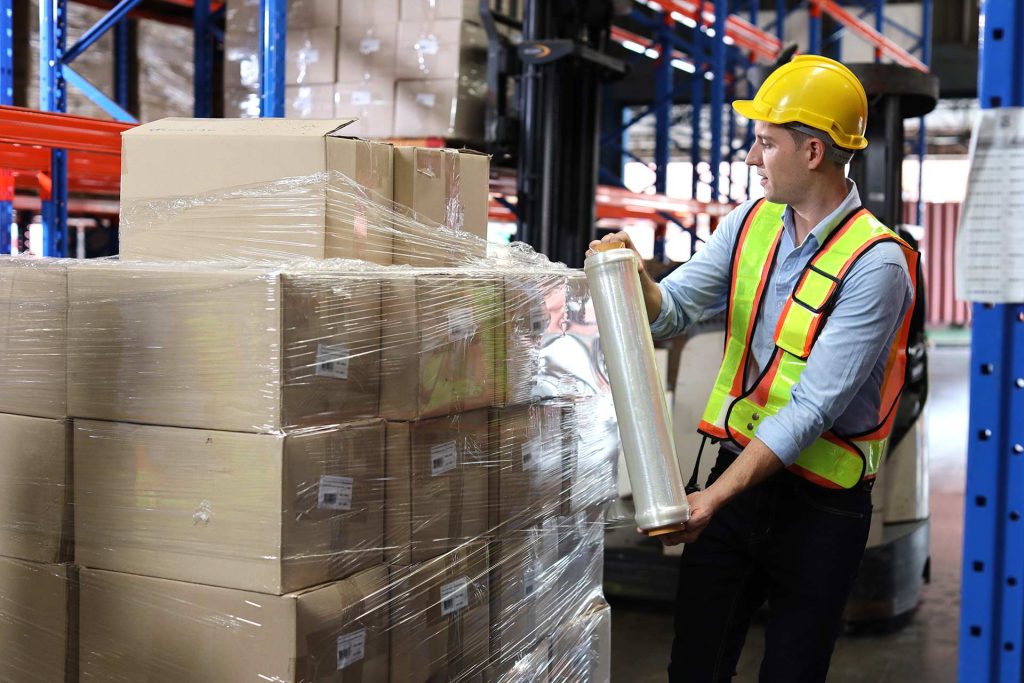
Hot trailers, softening adhesives, and long over-the-road routes put pallets under real stress in summer. Heat magnifies small mistakes in pallet building, which can become lean angles, crushed corners, and product shift that shows up as damage on arrival. Distribution center managers preparing for hot-weather shipping need practical guidance on stretch vs. shrink, when to add edge protection and layer sheets, and how to stabilize lanes with dunnage bags and strapping to ensure freight arrives intact.
Breckenridge Paper & Packaging supports organizations that want consistent pallet stability with cost-effective materials readily available from regional stock, technical guidance that aligns materials with equipment and routes, and a customer-first mentality that emphasizes repeatable performance and lower total landed damage costs.
The focus below is simple: build stable pallets that breathe, choose wraps and papers that behave predictably in heat, transfer loads to the pallet through edge protection and chipboard, and lock the trailer with dunnage and strapping practices that stand up to summer expansion, vibration, and stop-and-go dynamics.
Stretch wrap vs. shrink wrap vs. kraft paper interleaving
Stretch wrap is the default for most mixed and uniform pallets because it delivers containment through film tension, conforms around irregular loads, and allows selective venting for airflow. Hand and machine grades can be specified in blown or cast constructions, including pre-stretched and vented options that reduce neck-down and help heat escape from the load. For stocked options that support next-day shipment, Breckenridge supplies a broad range of pallet shrink wrap and stretch film, with guidance on gauge, pre-stretch settings, and wrap patterns that balance containment with film economy.
Shrink wrap, in contrast, is a heat-applied overwrap that tightens uniformly after application, and is excellent for unitizing homogeneous goods, bundling multipacks, or adding moisture protection around stable cube loads. In hot months, plan for controlled cooling time so residual heat does not trap moisture or deform temperature-sensitive products. Polyolefin and LDPE shrink families each have profiles for clarity, toughness, and perforation that support venting; see shrink packaging film options, including polyolefin shrink film, industrial shrink film, and shrink wrap packaging, when a heat-applied sleeve or overwrap is the right method.
Kraft paper interleaving is not a containment method; it is a friction and anti-slip layer between tiers or between the top layer and the cap. In summer, kraft helps manage micro-shifts caused by softened carton surfaces and vibration, creating friction that resists slide without sealing heat inside a load. It is also useful as a breathable slip sheet when there is a risk of condensation. For paper and board solutions, including kraft paper and corrugated board sheets, the selection of basis weight and finish controls both grip and tear resistance.
Bottom line, use stretch wrap when you need elastic containment and flexibility across mixed SKUs, use shrink when a tight, uniform overwrap is desired on stable, heat-tolerant packs, and use kraft paper interleaving to add friction, breathability, and tier control without adding plastic mass.
When to add edge protection and chipboard layer sheets
Edge protection transfers vertical and lateral forces away from product corners into a more rigid column, improving stackability and protecting carton edges under strap tension. Add edge protection when loads exceed typical wrap-only compression limits, when strap indentation is a risk, or when vertical columns are tall relative to base footprint. Chipboard layer sheets distribute weight across irregular tops, reduce point loading from cartons below, and create flatter surfaces that reduce lean at height. In summer, softened corrugate and adhesives can creep under load; edge protectors and chipboard counter this by distributing forces and preventing corner crush that leads to wrap loosening.
Breckenridge stocks corner and edge protector solutions, along with chipboard layer sheets sized for common pallet footprints, and offers specification help that aligns thickness with strap type, film tension, and height.
Dunnage air bags and strapping for over-the-road loads
Inside the trailer, lateral gaps between pallets, walls, and end doors create movement during curves and braking. An air dunnage bag fills the void and creates a compressive brace that stabilizes the lane; proper inflation with a calibrated inflator and placement at mid-height are critical. Combine dunnage bags with strapping for added restraint and load integrity at the pallet level. Poly strapping is common for mixed goods; steel banding is preferred for very heavy, rigid loads and high-heat environments where elongation control is vital. For stocked solutions that ship quickly, Breckenridge supplies air dunnage bags and strapping, as well as compatible inflators, tools, and seals.
Plan for summer expansion; avoid overinflating bags in a cool dock if the trailer will heat to 120 degrees Fahrenheit; verify relief valves and inflation targets; and ensure the bag surface is protected from sharp edges with chipboard or corrugate pads at contact points.
The best way to wrap a pallet in summer
There is no single universal pattern, but consistent principles apply. Start with a stable base, align cartons in an interlocked pattern that avoids chimney stacking unless airflow and product type require it, and use 3 to 5 bottom wraps to capture the pallet deck boards, then spiral up with 10 to 50 percent overlap based on film gauge and load profile, reinforce high-risk tiers with extra passes, and finish with 3 to 5 top wraps that neck-and-tuck to prevent tails. Use vented or pre-stretched film when heat buildup is likely, and avoid drum-tight over-tension that can deform cartons as adhesives soften. Machine wrapping should be tuned to meet containment force targets validated through testing, while hand wrapping benefits from a consistent walk speed and a pre-stretch carriage or pre-stretched film to achieve repeatable containment.
Quick checklist for safe pallet building in heat
- Choose the right containment: stretch for flexibility, shrink for uniform units, kraft for friction between tiers.
- Add edge protectors and chipboard when the height is greater than 1.5 times the base width, when strapping is used, or when cartons are softening.
- Mind height and weight distribution: keep the heaviest tiers low, avoid overhanging cartons, and cap tall columns with a rigid top sheet.
- Preserve airflow: use vented films or perforated shrink wrap where heat retention is a risk, and avoid full poly sheeting overwraps that trap heat unless moisture protection requires it.
- Stabilize the lane: fill trailer voids with dunnage bags, secure with appropriate strapping, and pad sharp areas to prevent puncture.
- Validate and recheck: do a push test and a short stop-and-go simulation in the yard; rewrap weak tiers and adjust containment force settings.
Frequently asked questions
What is kraft paper?
Kraft paper is a strong, wood-pulp paper known for high tear resistance and natural breathability, used as interleaving between pallet tiers, as slip sheets, and as void fill or wrapping where friction, abrasion control, and airflow are preferred over plastic films.
What is meant by protective packaging?
Protective packaging refers to materials and methods that prevent damage during distribution from shock, vibration, compression, puncture, and moisture, including foams, bubbles, paper systems, edge protectors, layer sheets, wraps, and dunnage that contain, cushion, and stabilize goods. Explore Breckenridge’s protective packaging range for category details.
What is package protection?
Package protection is the outcome of a designed system that preserves product condition from pack-out to delivery, typically combining containment (wraps and strapping), cushioning (foam, bubble), blocking and bracing (paper, air systems, dunnage), and structural components (corrugate, edge protection) aligned to hazards and routes.
What is the best way to wrap a pallet?
The best method is the one that meets containment-force targets with the least material and minimal heat retention. For most summer shipments, this means tuned machine stretch with vented or pre-stretched film, solid base capture, reinforced mid-tiers, and a secure top finish, plus edge protection where strap or height demands it.
Is pallet wrap the same as shrink wrap?
No. Pallet wrap (stretch film) relies on elastic tension without heat; shrink wrap requires heat to contract after application. They solve different problems and are specified based on load type, airflow needs, and desired moisture or tamper presentation. If a heat-applied solution is needed, review shrink packaging film choices for suitability.
Summer considerations for airflow and adhesives
Heat softens carton seals and can expand headspace in primary packs. Choose tapes and case-seal methods rated for elevated temperatures, avoid overwrapping that traps heat against products that off-gas or deform, and use perforated shrink or vented stretch on hot lanes to let heat escape. Where moisture exposure is limited, kraft interleaving helps the load breathe while improving anti-slip performance. Where moisture protection is required, balance barrier goals with venting, and consider staged cooling in the dock before final trailer close-up.
Why partner with Breckenridge for summer readiness
Breckenridge brings 30 years of trusted sourcing, specification support, and a customer-first mentality, with inventory positioned across Ohio, Michigan, and Pennsylvania for quick turns on common sizes and next-day shipment on many stocked items. The team helps match film gauges to equipment, specify edge protectors and chipboard to load geometry, plan dunnage bag sizes and inflation, align strapping grades to payloads, and validate settings under ASTM and ISTA frameworks so decisions are simplified and results are repeatable. When program optimization or a seasonal tune-up is needed, request packaging consulting support to right-size materials, reduce damage, and improve throughput.
Summary and next step
Summer shipping rewards the teams that build stable, breathable pallets, use the right wrap for the job, add edge protection and chipboard when height and heat demand it, and lock lanes with dunnage and strapping that hold through every curve and stop. Breckenridge can ship stretch film, edge protectors, and dunnage bags from the nearest warehouse on many stocked items as soon as the next day, with specification help that keeps loads intact and costs controlled. Call 800-644-6548 or contact your local branch to set up materials and a quick line review before temperatures rise.
Copyright Breckenridge Paper & Packaging. All rights reserved. Site content, product names, and company names are trademarks or registered trademarks of their respective holders.